
Guides · 22 พฤศจิกายน 2569
Phuket beyond the beach: the old town and the island's other half
Phuket is Thailand's biggest island and most visitors see one strip of its west coast. This guide spends its time on the other Phuket: the Sino-Portuguese shophouse streets of the old town, its Peranakan food, its shrines and museums, and the working island around it, then sets the beaches back into their proper place as one part of a bigger island rather than the whole of it.
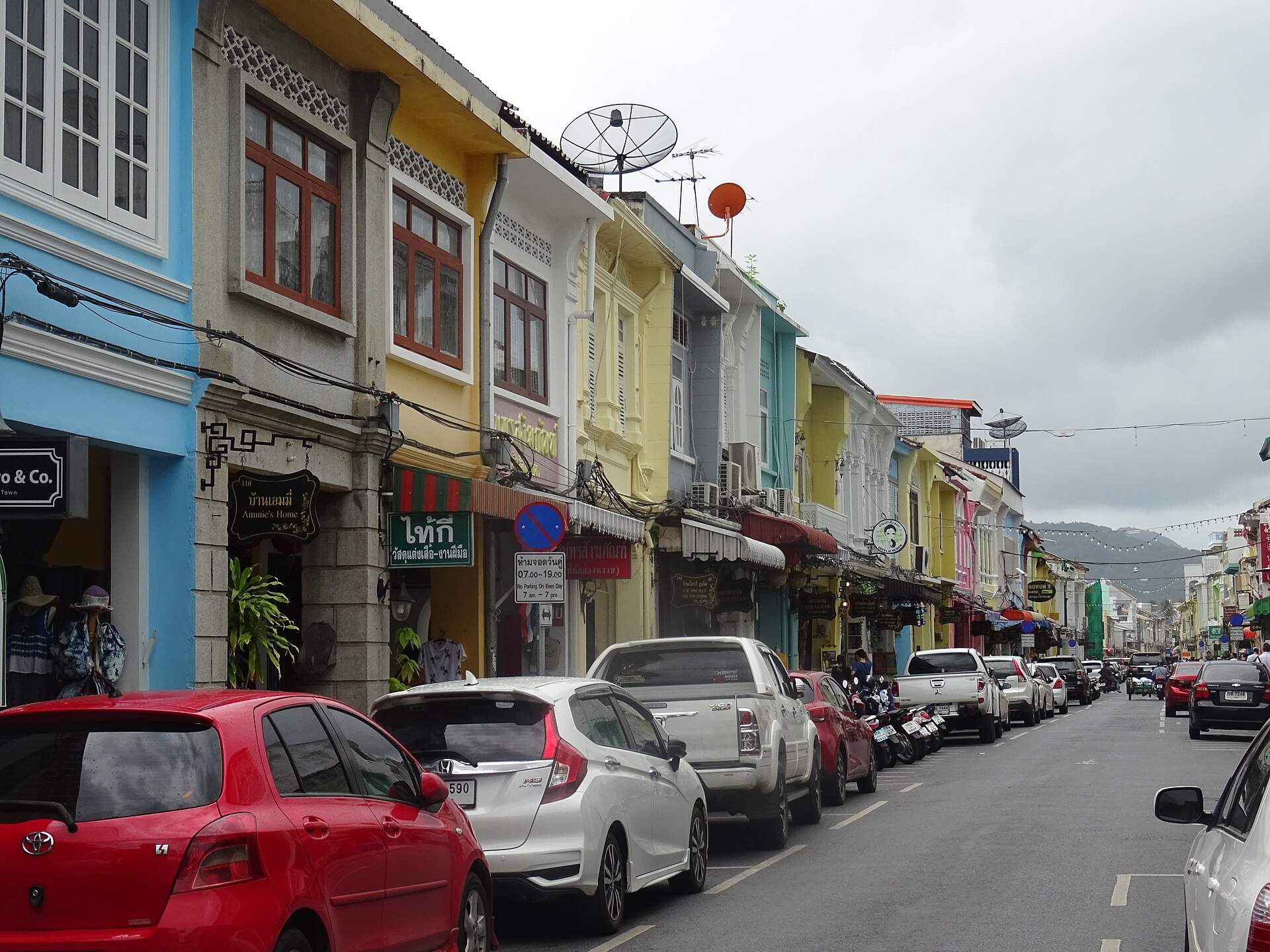
Phuket has a reputation, and the reputation belongs to about a fifth of it. The island is the largest in Thailand, a province in its own right, with a working capital, a deep Chinese and Peranakan heritage, and an interior of hills, rubber plantations and reservoir lakes that most beach holidays never enter. Patong and the west coast resorts are real, and the beaches are genuinely good. But a trip that never leaves the coast road misses the island that explains itself: Phuket Town, where tin money built one of the prettiest old quarters in Southeast Asia, and where the island's food, shrines and Sunday night market all belong to the people who live here. This guide is built around that other half, and puts the beach back in at the end, in proportion. Our events calendar carries the island's listings, from regatta week to the old town festivals.
The old town: a morning on Thalang Road
Start on Thalang Road, in the centre of Phuket Town on the island's southeast side. The street and its neighbours, Dibuk, Krabi, Phang Nga and Yaowarat roads and the little lane of Soi Romanee, form the old quarter: rows of two-storey shophouses built in the Sino-Portuguese style during the tin boom of the late nineteenth and early twentieth centuries, when Hokkien Chinese miners and traders, many arriving by way of Penang, made the island rich. The form is consistent and worth reading as you walk: a shop at street level, the family above, shutters and stucco decoration on the facade, and a covered walkway, the five foot way, running along the front to shade the pavement from sun and rain. The houses are narrow and very deep, some running back 50 metres or more, with rooms, kitchens and even wells behind the shopfront.
Phuket Municipality and the Thalang Road community run guided walking street tours of the old town on Tuesdays and Saturdays, and the quarter repays a slow morning even without one. Go early, when the light is on the facades and the cafes are opening. The Thai Hua Museum, in a former Chinese school on Krabi Road, is the place for the quarter's history, and the shrines, Jui Tui among them, are working temples first and sights second: dress and behave accordingly. Soi Romanee, the most photographed lane off Thalang, was the quarter's red-light lane a century ago; today it is ice cream shops and pastel walls, and it is prettier before the tour groups reach it at midday.
The food is the argument
If the architecture is the old town's face, the food is its voice, and Phuket's kitchen is not generic Thai. The island's Peranakan, or Baba, cooking blends Hokkien Chinese technique with Malay and southern Thai heat: Hokkien noodles in a rich broth, moo hong, pork belly braised in soy and spice, oh tao, a fried oyster and taro dish served at old town stalls, and the morning dim sum houses where Phuket starts its day early and socially. The Tourism Authority of Thailand's Phuket coverage treats the old town as a food destination in its own right, and UNESCO added weight to that in 2015 when Phuket was designated a Creative City of Gastronomy, the first city in Thailand to hold the title. Eat where the town eats: the kopitiam-style cafes on and around Thalang and Dibuk, the morning markets, and the noodle shops with no English menu and a queue. A beach resort breakfast is a poor trade for any of it.
Sunday night: Lard Yai
Time the old town for a Sunday if you can. Every Sunday the walking street market, Lard Yai, closes Thalang Road to traffic from 4.00 in the afternoon to 10.00 in the evening, on the Tourism Authority of Thailand's published hours, and the shophouse street becomes a kilometre of food stalls, crafts and street performance. It is the old town at its most itself: local families doing their Sunday evening, visitors woven through, and the facades lit behind the stalls. Arrive at opening, eat in stages, and walk the full length before you commit to a second helping of anything. The market also solves the old town's one weakness, which is that its streets can feel quiet on a weekday evening; on a Sunday there is no quiet to apologise for.
The island around the town
The other half of Phuket is not only urban. Wat Chalong, south of the town, is the island's most important temple, a tall, ornate chedi complex that draws Thai visitors in numbers no beach matches. Above it in the Nakkerd Hills stands the Big Buddha, a 45 metre marble image visible from much of the south of the island, reached by a winding hill road, with the view from its terrace doing the work of a map: Chalong Bay below, the town to the north, the west coast beaches laid out along the far side. Khao Rang, the hill inside the town itself, gives the nearer version of that view, over the rooftops to the sea. And the island's east coast, the side the resort brochures skip, is the working shore: fishing communities, mangroves, the Bang Rong community's kayaking among them, and seafood restaurants on piers where the catch is the menu.
None of this requires a car of your own, but it does require a base decision. Sleeping in the old town puts the mornings, the food and the Sunday market on your doorstep and the beaches at a day trip's distance across the island. Sleeping on the west coast reverses the equation, and in practice the town becomes the excursion that gets dropped. For a first trip that wants the whole island, the town base is the recommendation, with beach days taken as they come.
Book the Phuket custom tourvia Klook · affiliate link
Stay in Phuketvia Booking.com · affiliate link
One bay further: Phang Nga from Phuket
The old town also changes what a Phuket boat day can be. Most beach-based visitors meet Phang Nga Bay as a long transfer; from the town side of the island, the bay's piers are the near option, and the bay itself is the Andaman's other masterpiece: a sheltered sea of limestone islands, lagoons and mangroves between Phuket and Krabi, calmer than the open coast and workable in weather that closes the outer islands. The famous name in it is Khao Phing Kan, known worldwide as James Bond Island since the 1970s film that shot there, with the needle rock of Ko Ta Pu in front of it; the bay rewards the traveller who treats that stop as one among many and gives time to the lagoon canoeing and the stilt village of Ko Panyi, where a Muslim fishing community lives over the water as it has for generations. A Phuket trip that pairs the old town with a bay day and a beach day has used the island whole: its history, its enclosed sea and its open coast, which is more than most fortnights here manage.
Book the Phang Nga Bay day trip from Phuketvia Klook · affiliate link
The beaches, in their place
The west coast earns its fame in the dry season: Kata and Karon for long sand and swimmable water, Kamala quieter to the north, Surin and Bang Tao upmarket, and the sunset at Promthep Cape, the island's southern tip, as the evening ritual. Patong is the nightlife strip and makes no apology for it. What the other half of the island adds is not a rival to any of that but a reason the trip lasts longer and reads richer: a morning of shophouses and dim sum before the beach, a Sunday night market after it. Phuket beyond the beach is not a correction to the beach holiday. It is the rest of the island, and it was there first.
อ่านเพิ่มเติมได้ที่หน้าบทความ, หรือไปที่ปฏิทินกิจกรรมโดยตรง
อีเวนต์น่าสนใจ ส่งตรงถึงอินบ็อกซ์ของคุณ
รับอีเวนต์น่าสนใจสำหรับสุดสัปดาห์และหลังจากนั้น ทุกวันพุธ ส่งตรงถึงอินบ็อกซ์ของคุณ